A crooked or stiff finger is not automatically a surgical problem, but a deformity that prevents you from opening your hand, pinching, gripping, or releasing objects deserves a closer look. You will learn how to recognise function-limiting deformities, when an injury needs urgent assessment, what an evaluation measures, and how to compare therapy, splinting, and correction.
Key takeaways
- Assess deformities that limit grip, finger motion, release, or everyday tasks.
- Seek prompt care after injury, sudden change, severe pain, numbness, or colour change.
- Compare splinting, therapy, injections, and surgery based on the cause and function lost.
- Correction can improve movement but may involve rehabilitation, stiffness, scars, or recurrence.
Which hand deformities interfere with everyday movement?
Function, not appearance, determines whether a hand deformity needs attention: inability to fully straighten or bend, grip a cup, turn a key, type, dress, use tools, or release a grasp. A painless crooked finger can work well, while a subtle contracture can block daily use.
| Deformity | How it limits movement | Practical sign |
|---|---|---|
| Crooked finger after fracture | A poorly aligned bone changes tendon pull and joint contact | The finger crosses its neighbour or misses the thumb during grasping |
| Boutonniere deformity | A bent proximal interphalangeal joint reduces extension and can stiffen | Trouble opening the hand or placing it flat |
| Mallet finger | Loss of fingertip extension affects release and object handling | The fingertip droops and catches during dressing |
| Trigger-related contracture | Persistent flexion at the finger base prevents full opening | The finger locks or stays bent after gripping |
| Thumb deformity | Loss of opposition or pinch alignment weakens precision tasks | Difficulty turning a key, buttoning, or holding a pen |
| Dupuytren contracture | A cord pulls one or more fingers toward the palm | You cannot place the hand flat on a table |
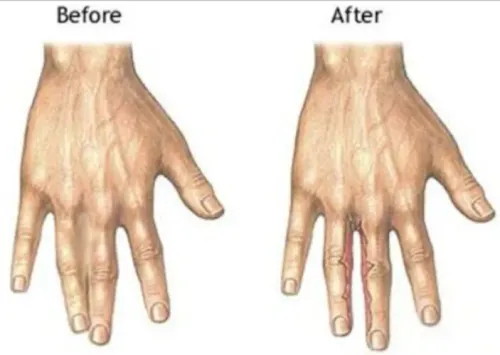
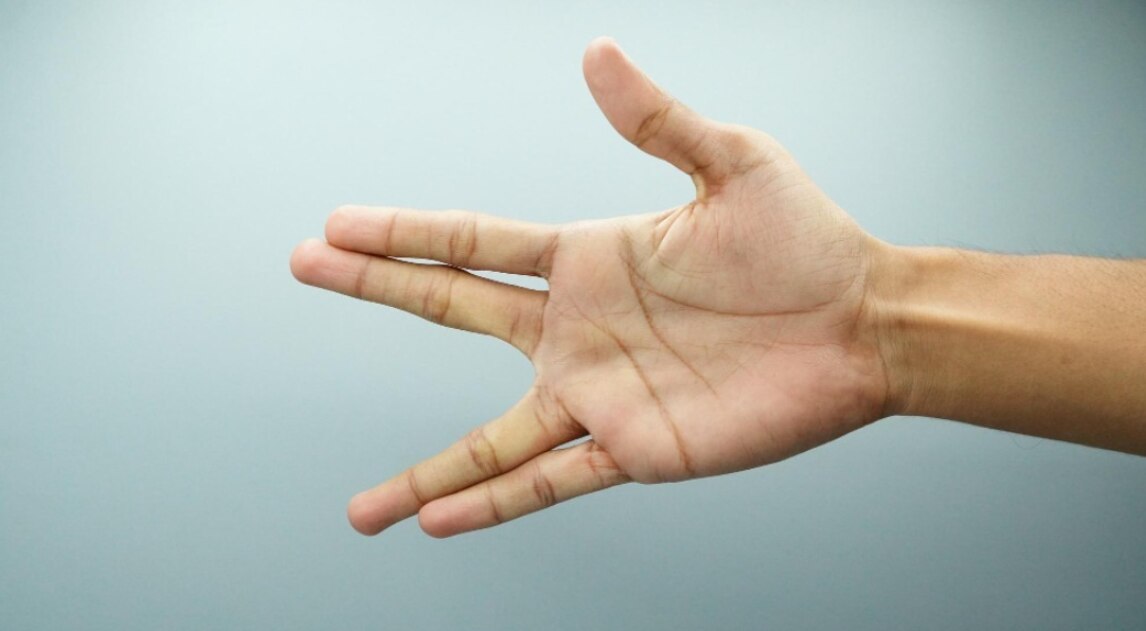
| Joint contracture or syndactyly | Restricted joint or joined fingers reduce reach and separation | Difficulty spreading fingers or using two hands together |
The same angle can matter greatly in the thumb or index finger and little in another digit. Compare active and passive motion: swelling, tendon injury, nerve dysfunction, arthritis, or a fixed joint problem require different treatment, so a photograph alone cannot show the functional cause.
When does a deformity need prompt assessment?
Seek prompt assessment when a hand problem changes alignment, movement, sensation, or practical use. A new deformity after injury needs examination even if pain is settling, because a poorly healed fracture, dislocation, ligament injury, or tendon rupture can worsen function.
Use this sequence to judge how urgently you need help:
1. Compare active and passive movement. If you cannot straighten or bend a finger yourself but someone else can move it fully, suspect tendon injury, swelling, or nerve dysfunction.
If passive movement is also restricted, a fixed contracture, scar, damaged joint surface, arthritis, or malunion may be blocking the joint; a tendon repair alone will not release it.
2. Check the pattern over time. Swelling usually changes as inflammation settles. Arthritis tends to cause recurring pain, stiffness, and reduced motion. A fracture that healed shortened, tilted, or out of alignment can reduce wrist rotation, grip, or the ability to place your hand flat on a table.
3. Seek emergency care for a pale or blue finger, numbness, loss of active movement, severe swelling, an open wound, uncontrolled bleeding, or a finger that looks newly crooked after trauma. These signs can indicate impaired blood flow, nerve injury, tendon disruption, fracture, or dislocation.
Even without emergency signs, arrange assessment when you cannot grip a cup, turn a key, type, dress, use tools, or release a grasp. Prompt evaluation preserves options before stiffness, scar, or prolonged nerve dysfunction makes useful movement harder to recover.
What happens during a hand deformity evaluation?
Timing helps separate a fixed deformity from a recent, reversible problem. Tell the examiner when the change began, whether it followed an injury or operation, and whether swelling, pain, numbness, or weakness is changing. Demonstrate tasks such as buttoning, writing, turning a key, lifting a cup, or placing your palm flat on a table.
- Active range of motion shows what you can move using your own muscles and tendons; a gap between active and passive motion points toward tendon damage, adhesions, pain, or nerve-related weakness.
- Passive range of motion shows what the examiner can move when you relax. Restriction here suggests a tight capsule, collateral ligament, volar plate, scar, or damaged joint surface rather than tendon imbalance alone.
- Tendon testing checks whether each flexor and extensor moves the intended joint. Nerve testing checks sensation, muscle activation, and patterns such as finger drop or loss of thumb opposition.
- A grip and pinch assessment measures useful force and exposes problems with grasping, key pinch, or fingertip control.
- Comparing the opposite hand provides a personal baseline for motion, strength, alignment, sensation, and joint stability.
- The examiner inspects bone and joint contour, ligament stability, skin scars or tightening, and tendon tracking.
Imaging completes the picture. An X-ray for joint alignment can show a poorly healed fracture, dislocation, arthritis, or joint-surface collapse; ultrasound or MRI can clarify tendon, ligament, scar, or soft-tissue injury when examination alone cannot.
Which non-surgical options should you compare first?
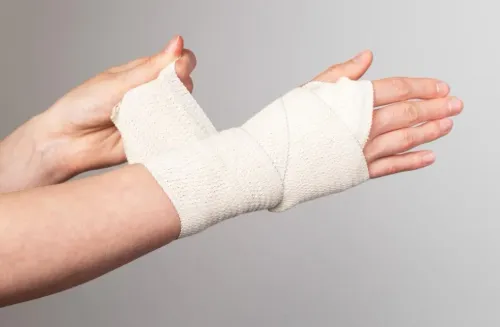
Start with options that address a reversible cause rather than trying to force a rigid joint. Hand therapy can improve tendon glide, strength, coordination, and active range; exercises work best when the joint still moves passively. Splinting can protect a healing structure or gradually support correction, while edema control reduces swelling that blocks motion.
| Option | When to compare it | What it cannot do |
|---|---|---|
| Hand therapy and exercises | Movement loss follows injury, swelling, weakness, or tendon imbalance | Cannot release a scarred joint or divided tendon |
| Splinting | A boutonnière deformity is early, or a joint needs protection and positioning | Cannot reliably straighten a chronic, fixed contracture |
| Activity changes | Repetition, force, or awkward grip worsens symptoms | Cannot correct altered bone or a shortened joint capsule |
| Anti-inflammatory treatment | Pain and swelling come from arthritis or an inflammatory flare | Cannot reverse established deformity |
| Arthritis treatment | Thumb-base or finger-joint pain limits useful grip | Cannot rebuild destroyed cartilage or realign a joint |
| Nerve-disease treatment | Compression causes weakness, numbness, or imbalance | Cannot restore muscle lost after prolonged denervation |
Treating nerve compression or systemic arthritis can restore useful function before permanent damage develops. For a Dupuytren contracture, therapy may preserve motion, but it cannot physically release a tight cord.
If the finger remains bent when you relax and someone else tries to straighten it, ask whether a fixed contracture, scar, bone problem, or shortened joint—not weakness alone—is limiting movement.
When can correction improve function, and what trade-offs follow?
Correction helps when it restores a usable path for a tendon, joint, bone, or nerve—not merely a straighter silhouette. Choose it by flexibility, pain, joint condition, and the function you need.
- Chronic mallet deformity may improve with tendon or joint surgery, but stiffness and incomplete extension remain possible. Boutonniere surgery needs a supple joint; a fixed joint can become stiffer.
- Needle fasciotomy suits a discrete Dupuytren cord when faster recovery matters. Open fasciectomy fits extensive, branching, recurrent, or skin-involving disease, but adds wound, nerve, stiffness, and rehabilitation burdens; recurrence remains possible. A small-finger proximal interphalangeal joint may retain flexion after release.
- For symptomatic distal-radius malunion, corrective osteotomy can improve rotation, grip, and load-bearing. Bone-healing problems, stiffness, tendon irritation, nerve symptoms, nonunion, or later hardware removal are trade-offs.
- Thumb-base arthritis surgery follows failed splinting, medication, injections, and activity changes. Trapeziectomy-based reconstruction can reduce pain, but pinch strength and dexterity recover over months and may be weaker early.
- Rheumatoid correction must address inflammation and the mechanical chain, including the wrist, extensor tendons, or several joints—not one finger in isolation.
- Nerve decompression or a tendon transfer can rebalance a palsied hand. Long-standing denervation, fixed joints, or severe sensory loss limits recovery.
Rehabilitation decides whether correction becomes useful movement. Protection comes first; graded motion and tendon retraining then limit stiffness. Dr.Kishan Rao uses passive motion, sensation, tendon status, and your daily tasks to help judge whether a procedure and its rehabilitation burden fit the problem.
Related service
Hand deformity correction is a type of surgical procedure that is designed to improve the function and appearance of the hands in individuals with... View service → |
Frequently asked questions
Which hand deformities interfere with everyday movement?
Deformities interfere with function when they prevent you from bending or straightening a finger, gripping or releasing objects, turning keys, typing, dressing, or using tools.
When does a hand deformity need prompt assessment?
Arrange prompt assessment after an injury or sudden deformity, or when severe pain, swelling, numbness, weakness, or a pale, blue, or cold finger appears.
What happens during a hand deformity evaluation?
The clinician reviews when the deformity began, examines alignment, skin, sensation, strength, and movement, and may order X-rays or other imaging to identify the cause.
Which non-surgical options should you compare first?
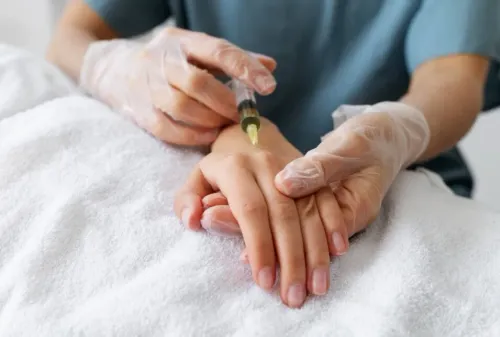
Depending on the cause, options include activity changes, hand therapy, stretching, splinting, pain relief, and injections before surgery is considered.
When can correction improve function, and what trade-offs follow?
Correction is most useful when a deformity blocks movement, grip, release, or hygiene. Trade-offs can include healing time, rehabilitation, stiffness, scars, nerve symptoms, and recurrence.