The effect of syndactyly depends on what connects the digits, where the connection lies, and whether the joined fingers grow at different rates. Understanding those differences helps you recognise which changes affect movement, which affect appearance, and what information a specialist needs when planning follow-up or reconstruction.
Key takeaways
- Simple syndactyly joins soft tissue; complex syndactyly can fuse bones, joints, nails, or tendons.
- Unequal finger growth can progressively bend or twist the joined digits.
- Assessment measures web extent, joint motion, sensation, circulation, and independent finger function.
- Specialists balance reconstruction timing with growth, function, surgical complexity, and follow-up needs.
What is joined, and how far does the web extend?
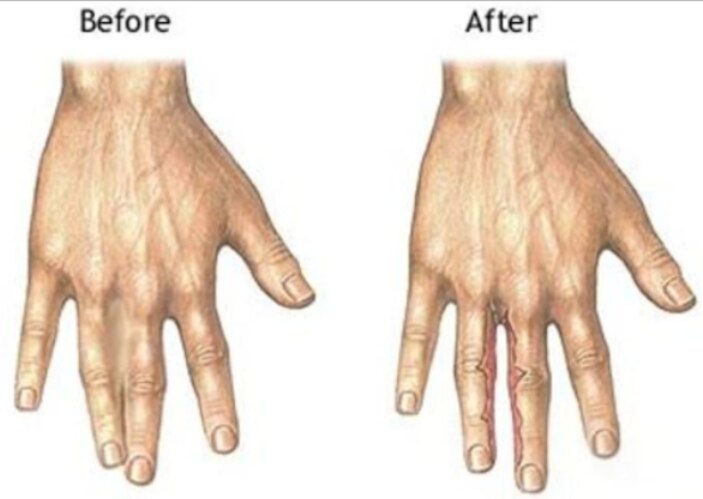
The effect depends on what is joined and how far the web travels toward the fingertip. Simple syndactyly connects skin and soft tissue while the bones and joints remain separate. Complex syndactyly includes fused bones, joints, nails, tendons, nerves, or blood vessels, so it is more likely to restrict independent movement and require intricate reconstruction.
| Pattern | What it means | Likely effect |
|---|---|---|
| Simple syndactyly | Skin and soft tissue only | Finger motion may remain close to normal |
| Complex syndactyly | Bone, joint, nail, or deeper-structure fusion | Greater risk of stiffness, altered sensation, or circulation problems |
| Incomplete syndactyly | The web ends before the fingertip | Some finger spreading and independent movement remain |
| Complete syndactyly | The web reaches the fingertip and may include one joined nail complex | Separation may require nail-fold reconstruction and can leave nail deformity |
The third web space, between the middle and ring fingers, is the commonest site in typical isolated syndactyly. A web involving the thumb or little finger deserves particular attention because it can disrupt grasp, finger spreading, and hand shape even when the bridge appears small.
Unequal length or growth between joined digits creates another problem: the longer finger can tether and pull the shorter one, gradually causing angulation and reducing independent motion. Assessment therefore includes finger length, active and passive movement, nail anatomy, sensation, circulation, and web pattern; radiographs help identify suspected bone or joint fusion.
Why unequal finger growth can create deformity over time
Growth does not affect joined fingers evenly. If one digit is longer or grows faster, it can tether the other and pull it toward its own line. The result may be progressive angulation, reduced independent motion, and a deformity that was barely visible in infancy.
The longer finger acts like a growing restraint. As the hand enlarges, the shorter digit may drift, rotate, or fail to spread fully, making grasp less balanced. A small skin bridge can therefore become more important when the underlying digits differ in length.
Border digits deserve particular attention because they shape the hand’s outer edges and contribute to spreading and grasping. Thumb-index syndactyly can restrict thumb opposition and pinch, while little-finger involvement can affect the hand’s ulnar border, finger opening, and ability to wrap around objects.
Ask for earlier specialist assessment when you notice:
- A joined finger bending increasingly toward its neighbour
- A widening difference in finger length
- Loss of independent spreading or bending
- The thumb struggling to meet the fingertips during pinch
- The little finger being pulled toward the ring finger or altering the hand’s shape
Timing is individualized. Markedly unequal digits and thumb-index syndactyly often receive attention earlier to limit tethering, while uncomplicated central webs may be managed later. The decision weighs deformity risk against anesthesia, wound care, and reconstruction needs.
How syndactyly changes movement, dexterity, and confidence
A useful hand can still feel different in daily life. Joined fingers may limit independent control, making tasks slower, less precise, or more tiring even when the child can dress, feed themselves, and play without major difficulty.
| Function | Possible effect | What you may notice |
|---|---|---|
| Pinch | Reduced ability to position fingertips separately | Difficulty picking up coins, fastening small buttons, or holding a pencil precisely |
| Grasp | Uneven finger movement or altered hand shape | A weaker grip on a cup, ball, bicycle handle, or large toy |
| Finger separation | Limited spreading between adjacent digits | Trouble reaching around wide objects or placing the hand flat |
| Handwriting | Less stable pencil control and reduced endurance | Larger letters, slower writing, awkward pencil grip, or hand fatigue |
Children often develop practical workarounds, such as using the other hand, changing their grip, or turning the wrist. Those strategies preserve independence but can hide how much effort a task requires. A child who avoids scissors, musical instruments, climbing, or games involving catching may be managing difficulty rather than lacking interest.
Confidence can change as well. A visible difference, unwanted questions, teasing, or comparison with classmates may make a child reluctant to show the hand, join activities, or remove clothing in front of peers. Adults may notice hesitation before the child reports a problem.
Ask what tasks feel difficult and which situations the child avoids; usefulness and confidence are separate parts of hand function.
What a developmental assessment needs to measure
A useful assessment compares the affected fingers with each other and with the opposite hand, rather than recording appearance alone. Clinicians measure finger length, inspect nail anatomy, and note whether the web reaches the fingertip. This shows whether unequal growth could tether the longer digit and gradually pull the shorter one out of alignment.
They also check:
- Joint motion: active movement shows what the child can control; passive movement reveals stiffness, contracture, or a hidden joint limitation.
- Sensation: age-appropriate responses to light touch help identify nerve involvement.
- Circulation: skin colour, warmth, capillary refill, and fingertip blood flow show whether vessels are affected.
- Bone structure: radiographs help when the fingers may share bone, joints, or other deep structures.
The clinician watches the child grasp, release, point, and use both hands during play. These observations reveal functional differences that a still examination can miss.
The rest of the child’s development matters too. Multiple affected web spaces, unusual limb shape, facial or skeletal findings, or delayed milestones can prompt examination for a broader limb-development condition and referral for genetics evaluation. The assessment therefore separates an isolated hand difference from a pattern that requires wider medical review.
How specialists weigh timing, reconstruction, and follow-up
Observation is reasonable when the web is incomplete, motion is preserved, the fingers are similar in length, and growth is not producing angulation. Monitoring still requires scheduled checks of finger length, alignment, motion, sensation, circulation, and nail development.
Timing balances deformity risk against anesthesia, wound care, and reconstruction demands. Thumb-index webs and webs joining markedly unequal-length digits are often addressed earlier because tethering can distort growth. Uncomplicated central webs are commonly treated later in infancy or early childhood.
Before choosing reconstruction, the surgeon maps the web and checks active and passive motion, nail anatomy, sensation, and circulation. Radiographs help identify fused bones or joints that skin release alone cannot correct. Dr.Kishan Rao uses this broader assessment to distinguish a surface problem from a deformity requiring deeper reconstruction.
- Observe when function and growth remain stable, with review if angulation, restricted motion, or unequal growth appears.
- Stage reconstruction when separating several webs at once would compromise blood supply, wound healing, or available skin.
- Reconstruct when tethering threatens alignment, dexterity, or the development of the thumb-index relationship.
After separation, the result is not always a normal hand. Skin grafts improve coverage but add a donor wound and can leave color or texture mismatch, contour differences, hair growth, or contracture. Graftless flaps avoid that donor site in selected patterns, yet scar contracture and web creep remain possible.
Postoperative splinting and dressings protect the new web, while therapy targets stiffness or contracture when they develop. A joined nail complex can require nail-fold reconstruction and still leave residual nail deformity.
Related service
Hand deformity correction is a type of surgical procedure that is designed to improve the function and appearance of the hands in individuals with... View service → |
Frequently asked questions
What is the difference between simple and complex syndactyly?
Simple syndactyly joins skin and soft tissue while the bones and joints remain separate. Complex syndactyly can involve fused bones, joints, nails, tendons, nerves, or blood vessels.
How can syndactyly cause deformity as the fingers grow?
When joined fingers grow at different rates, the faster-growing digit can pull, bend, or twist the other finger over time.
How can syndactyly affect hand function?
It can limit independent finger movement, reduce dexterity, and make tasks requiring precise separation or coordination more difficult.
What does a developmental assessment for syndactyly measure?
A specialist evaluates the web’s extent, finger and joint movement, bone and nail involvement, sensation, circulation, growth pattern, and practical hand function.